Skip to content
ExifTool.net

Online Images Metadata Viewer, Remover and Editor

Photos, screenshots, scans. EXIF, GPS, XMP, IPTC, camera serials, thumbnails, text chunks.

Cleaning options

Nothing here yet — add a file to begin.

How it works

How to view and remove EXIF data from photos

Four simple steps. Everything runs in your browser, so your photos never leave your device.

  1. Step 1

    Upload your file

    Drag a JPG, PNG, WebP, GIF, BMP, AVIF or TIFF photo into the lab, or tap Choose files to pick one from your device. You can also paste an image straight from your clipboard.
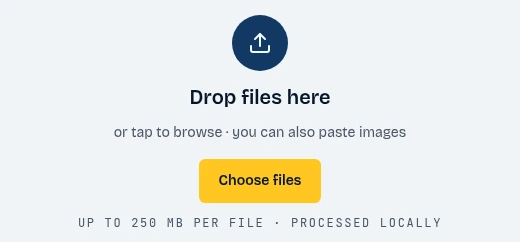
    The ExifTool.net drop zone with the Choose files button highlighted
    1. Click Choose files
  2. Step 2

    Show the data

    The report opens instantly. Browse EXIF, XMP and IPTC fields by group, spot GPS coordinates and camera serial numbers, and check the privacy exposure score.
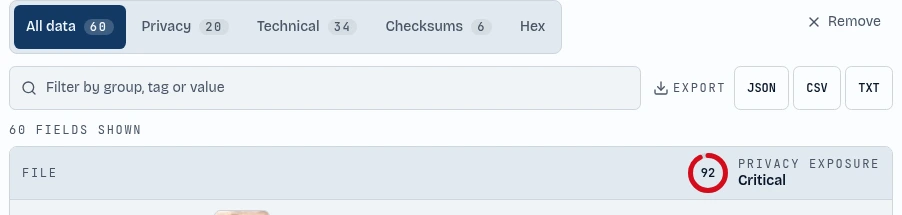
    The metadata report tabs and the privacy exposure score highlighted
    1. Browse every field
    2. See your privacy score
  3. Step 3

    Remove metadata

    Press Clean file and the EXIF, GPS, XMP, IPTC and thumbnail data is stripped in one tap. The tool then verifies that no fields remain, so you can post the photo safely.

    The Clean file button highlighted below the fields found counter
    1. Strip all metadata
  4. Step 4

    Metadata editor

    Want to keep some details? Press Edit EXIF, change the author, copyright, camera, date or GPS position, and save the photo with your own values.
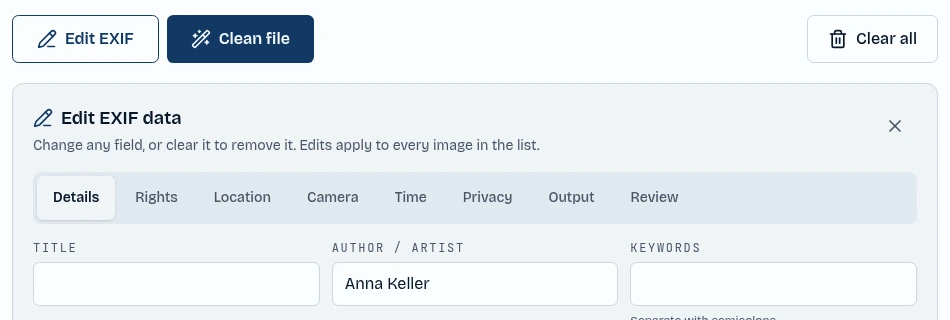
    The Edit EXIF button and the author field in the editor highlighted
    1. Open the editor
    2. Type a new value

About the tool

Online EXIF viewer and remover for photos

Every photo you take with a phone or camera carries EXIF metadata: the exact date and time, the camera make and model, lens and exposure settings, and very often the GPS coordinates of where the picture was taken. XMP and IPTC blocks can add the author, copyright, keywords and the software used to edit the image.

ExifTool.net reads all of this directly in your browser. Open a JPG, PNG, WebP, GIF, BMP, AVIF or TIFF file and you get a complete, searchable report grouped by category, with a clear privacy score that shows how much the photo reveals about you.

Because the image is processed locally with JavaScript, nothing is uploaded to a server. Standard cleaning rewrites the file structure without touching pixel data, so image quality stays exactly the same. An optional deep clean re-encodes the image when you want to be extra sure.

Features

Features of ExifTool.net

Everything you need to view, edit and remove metadata, in one private workspace.

View all EXIF, XMP and IPTC data

See every camera, lens, exposure, copyright and keyword field in a filterable report with privacy, technical and checksum views.

Remove GPS and camera details

Strip GPS coordinates, camera serial numbers, timestamps and embedded thumbnails, then verify the cleaned photo is really clean.

Edit EXIF data

Change the author, copyright, description, camera details, dates and GPS position, or clear any field you do not want to share.

GPS location and map link

Spot precise coordinates instantly, open them on a map, blur the precision to a wider area, or remove the location entirely.

Lossless standard cleaning

The standard mode never touches pixel data. Orientation is kept by default so portrait photos do not turn sideways.

Privacy exposure score

Every file gets a simple score from none to critical, so you know at a glance which files are risky to share.

100% private, no uploads

All parsing and cleaning runs in your browser tab. Your files never touch a server, and there is no account or sign-up.

Batch processing and ZIP export

Drop many files at once, clean or edit them together, and download everything as a single ZIP archive.

FAQ

Does removing EXIF data reduce photo quality?

No. Standard cleaning rewrites the file structure without touching pixel data, so the image looks exactly the same. Only the optional deep clean re-encodes the picture.

Which image formats are supported?

JPG, JPEG, PNG and WebP are cleaned in place. GIF, BMP, AVIF and TIFF are supported by re-encoding the image.

Why is the orientation tag kept by default?

Phones store rotation as metadata. Removing it can make portrait photos appear sideways, so only that single flag is kept unless you turn it off.

What about HEIC photos from an iPhone?

Browsers cannot decode HEIC reliably, so you are asked to convert the photo to JPEG first rather than risk a broken file.

Is my photo uploaded anywhere?

No. ExifTool.net processes everything locally with JavaScript in your browser. Your photos never leave your device.